A large congenital hairy nevus, hemangioma, or vascular birthmark can raise important questions for families, especially when it affects a child's face. These conditions are not all the same. Some involve pigment in the skin, while others involve blood vessels or tissue growth. Understanding the differences can help families find appropriate specialists and support.
At the Little Baby Face Foundation, we work with children whose facial differences may require specialized reconstructive care. In our experience, the name of a condition is only one part of the story. Its location, size, effect on daily activities, and the child's individual needs also matter.
Every child's condition is unique, and the information in this article is intended for general education, not medical advice. We encourage families to consult a qualified medical professional who can evaluate their child's specific condition and provide personalized guidance.
What Is the Difference Between a Birthmark, a Hemangioma, and a Hairy Nevus?
The word birthmark describes several types of marks or changes in the skin. It does not refer to one specific diagnosis.
Some birthmarks involve blood vessels. Others involve pigment, which gives skin its color. Certain facial growths are different from both.
Our medical team has experience with several conditions in these groups, including vascular birthmarks, hemangiomas, hairy nevi, arteriovenous malformations, and facial tumors.
Understanding these distinctions matters because conditions that look similar may have different medical needs.
Vascular Birthmarks
Vascular birthmarks involve differences in blood vessels. They may appear as red or discolored areas on the skin, including the face and neck.
Vascular birthmarks include hemangiomas and vascular malformations. Some can lead to complications that require specialized attention.
Hemangiomas
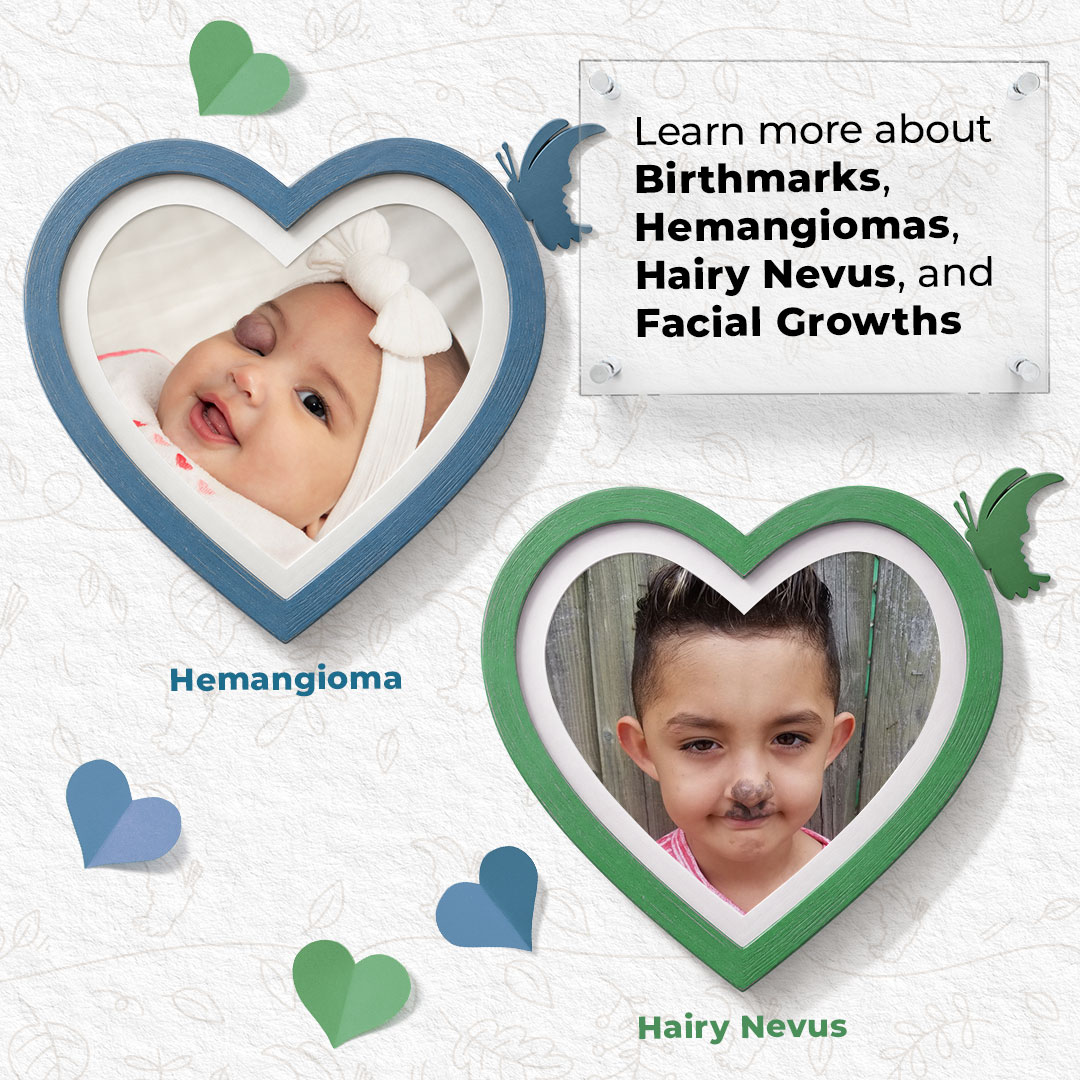
A hemangioma is a type of vascular birthmark made up of extra blood vessels. It may appear red or raised and can become noticeable shortly after birth.
Some hemangiomas shrink over time without treatment. Others can affect a child's health or daily activities, depending on their size and location.
Hairy Nevi
A hairy nevus, also called a congenital melanocytic nevus, is a pigmented birthmark present at birth. It may contain hair and can range from a small patch to an extensive area of skin.
How Are Vascular Malformations Different From Hemangiomas?
Vascular malformations also involve blood vessels, but they are not the same condition as hemangiomas.
An arteriovenous malformation is an abnormal connection between arteries and veins that disrupts normal blood flow. These malformations can occur on the face or scalp.
Venous malformations involve abnormal veins and may affect areas such as the lips, mouth, or surrounding facial tissues.
Unlike hemangiomas, vascular malformations do not typically follow the same pattern of early growth followed by shrinking.
Distinguishing between these conditions can be challenging because some may have similar visible features.
A child may initially receive one diagnosis before further evaluation identifies a different vascular condition. This distinction matters because the medical considerations and possible approaches to care can differ.
We understand that unfamiliar medical terms can make an already difficult situation more confusing. Knowing the difference between a hemangioma and a vascular malformation can help families better understand their child's diagnosis and the questions they may want to discuss with their medical team.
When Can Hemangiomas Affect a Child's Health?
A hemangioma is not automatically a serious medical problem. Many shrink over time without requiring major intervention.
However, the location and growth of a hemangioma can affect a child's health or everyday activities.
For example, a hemangioma near the eye may interfere with vision. One involving the mouth or lips may affect feeding or cause discomfort, particularly if the skin becomes irritated or develops an open sore.
These concerns are different from the cosmetic appearance of a birthmark. They involve how the condition affects a child's ability to carry out everyday activities.
At Little Baby Face Foundation, we recognize that two children with the same general diagnosis may have very different needs. A small hemangioma on one part of the face may present different concerns from a larger growth near the eye or mouth.
That is why individual medical assessment is important.
What Should Families Know About a Large Congenital Hairy Nevus?
A hairy nevus can appear on different parts of the body, including the forehead, scalp, nose, and other areas of the face. Its size and location can influence how complex the condition is to address.
Smaller nevi may be removed through a single surgical procedure when removal is appropriate. Larger nevi can present more complex reconstructive challenges, particularly when they cover a significant portion of the face or scalp.
For very large nevi, treatment may involve several stages. In some cases, surgeons may use tissue expanders, which gradually create additional skin that can be used during reconstruction.
Another consideration is that some nevi can undergo malignant changes. This does not mean every hairy nevus will become cancerous, but it is one reason individual medical evaluation matters.
In our experience, families often have questions about what makes one child's condition different from another's. The answer depends on more than the birthmark's appearance. Its size, location, and medical characteristics all play a role in determining what care may be appropriate.
What About Facial Tumors and Other Growths?
Not every facial growth is a birthmark.
Facial tumors are abnormal tissue growths that may be benign, meaning noncancerous, or malignant, meaning cancerous.
Some facial tumors may require surgical removal and reconstruction, particularly when they affect surrounding facial structures.
The medical needs of a child with a facial tumor can differ considerably from those of a child with a hemangioma, hairy nevus, or vascular malformation.
Our Foundation works with volunteer surgeons who have experience treating a range of complex facial differences. Their expertise helps us evaluate whether specialized reconstructive care may be appropriate for a child.
We also recognize that a visible growth does not always reveal its cause or medical significance. An individual medical review is necessary to understand the condition and determine appropriate next steps.
How Can Families Seek Help Through Little Baby Face Foundation?
Families come to us at different points in their search for care. Some have already received a diagnosis and are looking for access to specialized surgery. Others are trying to understand whether their child's facial difference may qualify for assistance.
We provide life-changing reconstructive surgery at no cost to children and families who are accepted into our program.
Our world-class volunteer surgeons donate their time and expertise. We help cover essential expenses, including operating room fees, anesthesia, travel, and lodging, so financial barriers do not prevent accepted children from receiving care.
Who Can Apply for Assistance?
Our eligibility guidelines require that:
- The person needing treatment is 21 years old or younger.
- The treatment is medically necessary.
- The family cannot afford the treatment.
- Appropriate treatment is not available locally.
We encourage families to apply even if they are unsure whether their child's condition qualifies. Our medical team reviews applications individually.
What Happens After a Family Applies?
The first step is completing our confidential online application.
Families provide information about their child's condition and a photograph of the affected area.
Our medical team then reviews the application to determine whether treatment may be available through the Foundation and which specialists may be appropriate.
Because we receive many applications, we ask families to allow approximately 2 to 12 weeks for a response.
If a child is accepted, our Surgical Coordinator helps arrange the visit and coordinate the necessary travel and accommodations.
Submitting an application does not guarantee acceptance or surgery, but it allows our medical team to consider the child's individual needs.
Helping Families Find a Path Forward
Birthmarks, hemangiomas, hairy nevi, vascular malformations, and facial tumors can have very different medical characteristics. Understanding those differences is an important starting point for families seeking answers.
At Little Baby Face Foundation, we believe every child deserves access to compassionate, specialized care, regardless of their family's financial circumstances.
If your child has a facial birthmark or growth that may require reconstructive surgery, we invite you to complete our confidential application. Our medical team will review your child's information and determine whether we may be able to help.
Frequently Asked Questions
Is a Hairy Nevus the Same as a Hemangioma?
No. A hairy nevus is a pigmented birthmark that may contain hair, while a hemangioma is a vascular birthmark made up of extra blood vessels. Although both can appear on the face, they are different conditions with different medical characteristics.
Does Every Child With a Facial Birthmark Need Surgery?
No. Some hemangiomas shrink over time without treatment, and not every birthmark requires surgical care. Other conditions may affect vision, feeding, or surrounding facial structures. Whether surgery is appropriate depends on the child's individual medical needs and specialist evaluation.
Can We Apply if Our Child Has a Facial Growth That Is Not Specifically Listed Among the Conditions You Treat?
Yes. We encourage families to apply even if their child's condition is not specifically listed. Our medical team reviews each application to determine whether the Foundation may be able to provide care. Applying does not guarantee acceptance.